
Before selecting a certification for an asset, it is essential to define the project’s sustainability objectives. These objectives determine the most suitable path, as well as the strategies and outcomes that can be achieved throughout its development. Once the path is defined, it becomes possible to identify the certification and the tools that best contribute to reaching those objectives.
What defines the path: the objective or the system?
Deciding on a path begins with the question, “what are you looking to achieve with the project?” The project’s objectives are what define the sustainability path and, from there, the most suitable strategy, tools, and certification.
Among the most common objectives in the built environment are:
- Reducing operating costs and energy and water consumption.
- Responding to the requirements of investors, funds, or corporate clients.
- Accessing green financing or better credit terms.
- Strengthening the organization’s or portfolio’s ESG (environmental, social, and governance) reporting.
- Differentiating the asset in the market or with tenants.
- Having verifiable and recognized evidence of the performance achieved.
In most cases, a project responds to several objectives at the same time. Identifying and prioritizing them from the outset makes it possible to define a coherent sustainability strategy and select the certification or tools that add the most value, avoiding the allocation of resources to initiatives that do not respond to the project’s real needs.
At THREE, from the first commercial contact through project kickoff, we validate the client’s goals and delve into their needs, priorities, and expectations. This allows us to understand what they are truly looking to achieve with sustainability and which aspects are most relevant to their project, whether that is operational efficiency, impact reduction, meeting ESG objectives, occupant well-being, or obtaining a certification.
Based on this definition, we can guide the strategy from the outset and integrate sustainability as a strategy aligned with the project’s objectives.
First decision: Should the project be certified?
Certification provides a recognized framework to measure, validate, and communicate a development’s performance. In addition to offering comparability, it is especially valuable when the objective is to respond to investor requirements, access sustainable financing, differentiate an asset in the market, or meet the expectations of clients and other stakeholders.
However, not all projects pursue those objectives from the outset. When the priority is to improve the performance of an existing building, reduce operating costs, or address specific efficiency opportunities, it may be more advisable to begin with other types of studies or strategies that make it possible to achieve those results. At a later stage, that progress can even serve as the basis for a certification process.
Which certification system corresponds to each priority?
Each system addresses a different priority. Rather than an exhaustive comparison, the decision starts from the project’s main priority.
Project priority: Comprehensive environmental performance (energy, water, materials, indoor environment)
System to consider: LEED
When it applies: New construction or operation, across multiple building types; when international recognition is sought.
Project priority: Measurable efficiency with an agile, cost-focused process.
System to consider: EDGE
When it applies: Housing at scale, offices, hotels, and industry; emerging markets. Requires a minimum 20% reduction in energy, water, and embodied carbon.
Project priority: Occupant health and well-being.
System to consider: WELL
When it applies: Offices, workspaces, and high-occupancy uses.
Project priority: Accessibility and inclusion (the social dimension of ESG)
System to consider: Access4you
When it applies: Spaces for public use; integrates with WELL and LEED.
Project priority: Zero waste and materials management.
System to consider: TRUE ZERO WASTE
When it applies: Office buildings, industrial plants, and others, it requires a minimum 90% waste diversion.
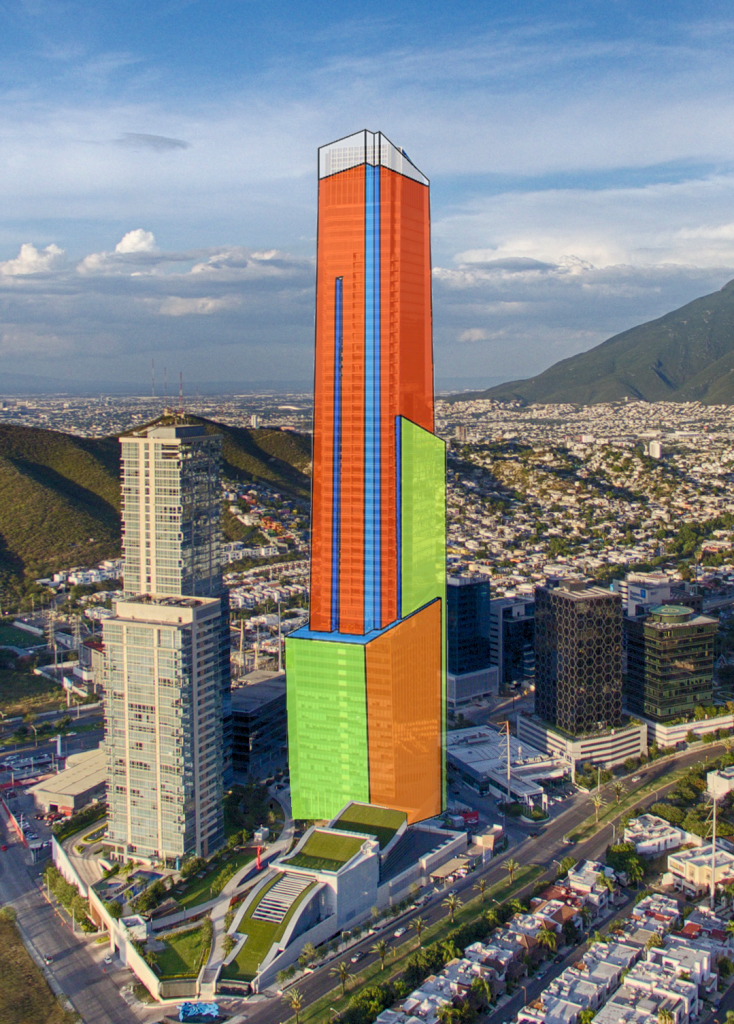
Energy Modeling of the KOI Tower | San Pedro Garza García, N.L.
What if the project is not seeking a certification?
As THREE, we are an environmental consultancy; that is, we support our clients in reducing the impact of their projects as our first mandate. There are studies, analyses, and activities that make it possible to reduce consumption, optimize operation, and generate verifiable results. In addition, if the project decides to pursue certification later on, many of them provide the evidence that systems such as LEED or EDGE require. The project stage determines which one is best to implement first. Some of these studies are:
Energy modeling
Energy modeling simulates the building’s performance before it is built. It compares scenarios of orientation, envelope, materials, and systems to estimate how each decision will influence energy consumption.
Its greatest value is obtained during the design stage, when decisions can still be adjusted at lower cost and with greater impact on the building’s future performance.
Commissioning (Cx)
Commissioning (Cx) verifies that energy and water systems are installed, tested, and operated in accordance with the project requirements and the design intent.
It is carried out mainly during construction and before the building’s handover, when it makes it possible to verify that systems are installed, tested, and operated according to the design. It can also be performed during operation to identify deviations, optimize performance, and reduce cost overruns stemming from poorly calibrated systems.
Water and energy submetering
Submetering records consumption by system, area, or use—such as lighting, HVAC, pumping, or irrigation—instead of measuring only the building’s total consumption.
Its main application is during operation, since it makes it possible to identify where consumption is concentrated, detect anomalies, and verify the impact of the efficiency measures implemented. It also forms the basis for measurement and verification processes and for gathering evidence in certifications such as LEED.
ESG roadmap
An ESG roadmap is a strategic plan that organizes objectives, indicators, owners, and actions across environmental, social, and governance matters.
It is especially useful when the decision goes beyond a single building and seeks to guide the strategy of a company or a real estate portfolio. It makes it possible to align design, construction, certification, and operation with measurable goals and with the requirements of investors, financial institutions, and other stakeholders.
Three questions to define the best path
The right path is defined by answering, in order:
- What is the project’s main objective?
- Does that objective require the backing of a recognized certification? This defines whether it is worth certifying and with which system.
- What stage is the project in? This defines which tools make sense to apply.
In most cases, the answer is not choosing between certification and technical tools, but combining both according to the project’s objectives and stage to maximize value.
At THREE, we support developers, owners, and investors in identifying the strategy that best fits each project. If you want to assess which is most suitable for yours, explore our services or contact us.
If you are still defining whether building sustainably is the right decision and what it entails, we invite you to read our article Sustainable construction: answers to the most frequently asked questions.